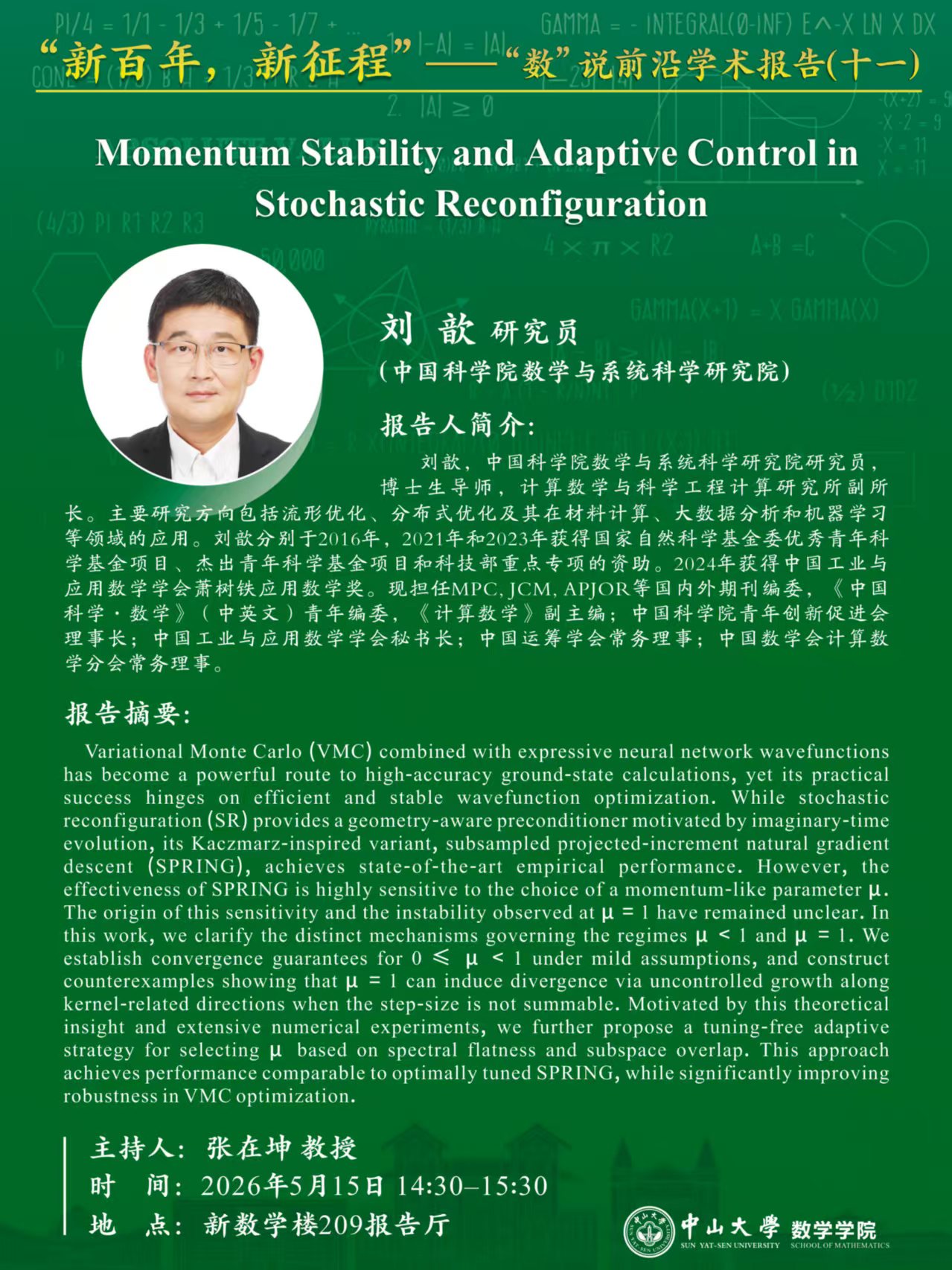
学术报告(刘歆 2026.5.15)
Momentum Stability and Adaptive Control in Stochastic Reconfiguration
摘要:Variational Monte Carlo (VMC) combined with expressive neural network wavefunctions has become a powerful route to high-accuracy ground-state calculations, yet its practical success
hinges on efficient and stable wavefunction optimization. While stochastic reconfiguration (SR) provides a geometry-aware preconditioner motivated by imaginary-time evolution, its Kaczmarz-inspired variant, subsampled projected-increment natural gradient descent (SPRING), achieves state-of-the-art empirical performance. However, the effectiveness of SPRING is highly sensitive to the choice of a momentum-like parameter μ. The origin of this sensitivity and the instability observed at μ = 1 have remained unclear. In this work, we clarify the distinct mechanisms governing the regimes μ < 1 and μ = 1. We establish convergence guarantees for 0 ≤ μ < 1 under mild assumptions, and construct counterexamples showing that μ = 1 can induce divergence via uncontrolled growth along kernel-related directions when the step-size is not summable. Motivated by this theoretical insight and extensive numerical experiments, we further propose a tuning-free adaptive strategy for selecting μ based on spectral flatness and subspace overlap. This approach achieves performance comparable to optimally tuned SPRING, while significantly improving robustness in VMC optimization.